

Shut-off Ball valve for commercial A/C and Refrigeration
Shut-off ball valves are used to open or shut off refrigerant flow in refrigeration systems and are suitable for bi-directional flow. They are used in liquid, suction, and hot gas lines, which makes them relevant wherever reliable isolation is needed during installation, service, or system operation. In cold room applications, shut-off ball valves are part of the wider line-component layer of the refrigeration circuit and support safe, practical system handling. Beyond cold rooms, the same valve category is also used in refrigeration, freezing, air conditioning, chillers, heat pumps, and transport refrigeration applications.
Features and benefits
- Full flow with minimum pressure drop
- Bi-directional flow, allowing flexible valve orientation in the system
- Long service life and low leakage or no leakage design
- Slim-line construction for easy handling and installation
- Copper plated tube supports safer and faster installation
- One-piece wire seal cap supports safety and helps prevent tampering
- Broad temperature range for refrigeration, freezing, and air conditioning applications
- Product variants are available for higher-pressure and CO₂-related applications
Product types shown: 7

GBC (90 bar) / GBCT (140 bar)
Danfoss shut-off ball valves, type GBC (90 bar), GBCT (140 bar) are manually operated shut-off valves for CO₂ refrigeration systems, in order to open and to shut off inner flow path by operating the valve spindle.
The valves are specifically designed for intrinsic standstill security, meaning that the valves can withstand pressures normally arising when the refrigeration system is shut off, i.e. during serving or during unexpected power failure.
The valve structure and materials are designed and tested specifically for use with CO₂ refrigerant.
GBC (90 bar) valves are designed to use in subcritical CO₂ refrigeration systems.
GBCT (140 bar) valves are approved for use in transcritical CO₂ systems.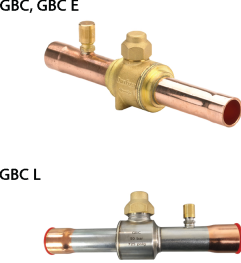
GBC / GBC E / GBC L
Danfoss shut-off ball valves, type GBC, are manually operated shut-off valves for refrigeration systems, in order to open and to shut off inner flow path by operating the valve spindle.
The GBC valves are used in liquid, suction and hot gas lines in refrigeration and air conditioning systems.
The GBC bi-directional ball valves can be delivered with or without external access port.
The valves have one-piece wire seal cap to prevent unintentional cap removal or tampering between services.
There are 3 different ranges, valid for different types of refrigerants, system sizes and made with different materials: GBC and GBC E in brass, GBC L in stainless steel.
OFB
OFB shut off ball valves are a suction solution for superior reliability of oil-free system featuring Danfoss Turbocor® compressors.
OFB shut off ball valves efficiently prevent from refrigerant migration during extended standby periods and therefore, from the risk of liquid slug upon compressor restart.


Cold Rooms
Shut-off ball valves are manual isolation valves used to control refrigerant flow in refrigeration systems. In cold room systems, they support serviceability, isolation, and line control in liquid, suction, and hot gas lines, making them a practical part of the wider refrigeration circuit. The category remains relevant outside cold rooms because the same valve families are also used in broader refrigeration, freezing, air conditioning, chiller, heat pump, and transport refrigeration applications.