

Indirect heating
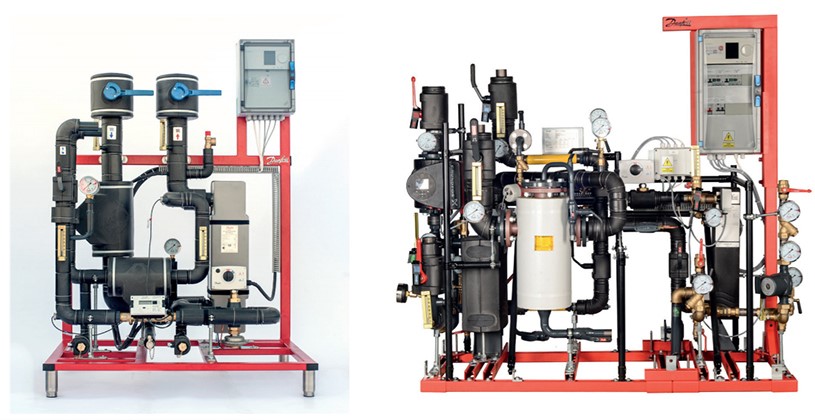
An indirect substation is used when district heating network conditions, such as pressure and temperature, do not allow direct connection. When a substation is connected indirectly, a heat exchanger provides energy-efficient heat transfer. It also ensures that the primary network supply side and the secondary building installation side remain safely separated.
An indirect substation is used when district heating network conditions, such as pressure and temperature, do not allow direct connection. When a substation is connected indirectly, a heat exchanger provides energy-efficient heat transfer. It also ensures that the primary network supply side and the secondary building installation side remain safely separated.
This way, the building application works regardless of pressure or temperature variations in the district heating network (hydronic balancing) and is safe from pipe breaks or leaks.
Danfoss indirect substations are self-contained units that are generally wall-mounted. They can support single or multiple heating circuits, with or without domestic hot water production on the primary or secondary side.
These advanced solutions are also available with an electronic controller for weather compensation. This ensures easy and energy-efficient operation while simultaneously allowing central monitoring and energy consumption transparency.
Features and benefits
- Integrated components ensure safe operation, increases durability and minimize whole life costs
- Benefit from optimized heat transfer and system control performance
- Compact design - Minimum space required for installation
- Thermostatic or electronic control of heating temperature
- Operates independently of differential pressure and flow temperature
- Low energy loss
- Wide capacity range – up to 20 MW
District Heating Substations operating guide
Use this document for planning indirect heating / cooling, dhw production and other water based heating systems. Can be used for DSA; DPS; DSE; DSS; DSM; and DSC product types.
Smaller, lighter, more efficient: Danfoss' compact substation DSA1 Mini | Deep-dive into the new VXe villa substation series |
Learn how the station is installed, as well as tips and tricks for commissioning and maintenance | This animation takes you inside each VXe indirect substation in the series and shows how the Danfoss-engineered core components work together to improve energy efficiency and substation performance. |
Video: | Animation: |
Modular, digital, and ready! | |
Check out the different variants of the new DSP MOD@ substation. | |
Animation: |
Product types shown: 31

DSA 1 MINI Heidelberg
The DSA 1 MINI is a compact, welded district heating transfer station. It is designed for the efficient transfer of heat from a local or district heating network to a building’s heating and domestic hot water systems. The station is equipped with all the necessary components and control functions to reliably meet the specific technical connection requirements (TAB) of Stadtwerke Heidelberg.

DSA1 HOME
The DSA HOME is designed for use in high-parameter district heating networks. Suitable for heating single houses. It provides an alternative solution to an oil or gas boiler. The DSA Home is designed for heating or heating and domestic hot water. The wall-mounted construction saves space needed for installation and servicing.

DSP 1 MAXI CEE
District heating transfer stations provide the link between district heating suppliers and customers’ systems. They incorporate the necessary equipment to tailor the supplied heat to the needs ofthe object premises as specified in the heating supply contract. In this they need to comply with all applicable standards and with the supplier’s technical connection conditions. Indirect connections (in which district heating and in-house systems are hydraulically isolated)incorporate components to separate the systems (heat exchanger), to limit the flow volume to that specified in the contract, regulate the secondary supply temperature and measure the energy consumption. The system described here is a standard type in whichone of different types of pump modules and different options can be connected on the secondary. Thus, this system is especially suitable for District Heating applications.

DSP MOD
District heating transfer stations provide the link between district heating suppliers and customers’ systems. They incorporate the necessary equipment to tailor the supplied heat to the needs of the object premises as specified in the heating supply contract. In this they need to comply with all applicable standards and with the supplier’s technical connection conditions. Indirect connections (in which district heating and in-house systems are hydraulically isolate) incorporate components to separate the systems (heat exchanger), to limit the flow volume to that specified in the contract, regulate the secondary supply temperature, and measure the energy consumption. The system described here is a standard type in which one different types of applications can be connected on the secondary.
DSP1 MAXI
District heating transfer stations provide the link between district heating suppliers and customers’ systems. They incorporate the necessary equipment to tailor the supplied heat to the needs of the object premises as specified in the heating supply contract. In this they need to comply with all applicable standards and with the supplier’s technical connection conditions.

DSP1 SMALL
The DSP MINI is designed for use in district heating networks, suitable for heating and for providing DHW for single family houses. It provides an alternative solution to an oil or gas boiler. The DSP MINI is designed for heating, domestic hot water and floor heating. The wall-mounted construction saves space which is needed for installation and service. The DSP MINI is designed as a wall-mounted sta tion. Each station is equipped with micro plate heat exchangers for DHW and optional for heating manufactured by Danfoss, which significantly increase substation performance and lifetime. All components are placed at the front of the station, which makes it very easy to access them during maintenance or servicing. The mounting bracket significantly reduces the time required to mount the substation to the wall. The connections are predefined and allow installers to prepare installation before station is available on the site, which reduces the time between delivery and startup.

DSS1 MAXI
District heating transfer stations provide the link between district heating suppliers and customers’ systems. They incorporate the necessary equipment to tailor the supplied heat to the needs of the object premises as specified in the heating supply contract. In this they need to comply with all applicable standards and with the supplier’s technical connection conditions. Indirect connections (in which district heating and in-house systems are hydraulically isolated) incorporate components to separate the systems (heat exchanger), to limit the flow volume to that specified in the contract, regulate the secondary supply temperature and measure the energy consumption. The system described here is a standard type where primary medium is steam. On secondary heating circuits or modules can be connected optional.

DSU Pro
DSU PRO is a welded district heating substation. It is designed to transfer thermal energy from a local or from a district heating network to the heating or a domestic water system in a building. The substation comprises devices as well as offers functionalities necessary to meet different district heating network connection conditions. The DSU PRO substation has been designed to secure high efficiency of the thermal energy transfer and thus offer the best possible performance as the thermal energy source for a building. The district heating network, being the primary side, and the heating or the domestic water systems in a building, being the secondary side, may need to be hydraulically separated from each other. To secure this the substation comprises a heat exchanger. The DSU PRO substation also offers devices and equipment for controlling and monitoring the contracted flows and temperatures as well as for measuring the energy used in the building. The substation design follows the main standards and requirements. Consequently, the substations can cover a wide range of applications in different markets.


